Right, I think that would be the real worry-- an alternative trading system. Not just one country doing it, but lots. Maybe some countries trade in petrodollars. Then the U.S. does something, or fails to do something, and they register their anger by changing to petroeuros. That would be a concern for the U.S.-- haing to adjust our foreign policy to please a range of nations for fear of the economic impact of angering them.
Dates
· UTC
The real reason behind all this gubbins with Iran?
Archived145 replies · 1,872 views
This is an archived legacy thread. Replies are closed, but the discussion is preserved.
← Back to Behind Closed Doors
Showing posts 91–120 of 146
↑ First post
Latest post ↓
I'm saying its just a contributory and valid theory. I can't see anything wrong with it. I suspect it's the domino effect it may have long term that makes it more valid.
I've never been happy with the WMD stuff; but if you put it in with this theory and others it makes sense.
I always believe that our current respective administrations do not do anything so drastic unless there is an economic benefit, capitalists they are.
Hell if it was about human rights we would have toppled Zimbabwe a while back.
It does seem to be a big trend to switch to the Euro too; Venezuela did it recently.
Perhaps its worth explaining that all transactions in oil were done in petrodollars from 1946.
The first person to buck this trend was Saddam, about 1997, of all people. The trend has since gone crazy since the introduction of the Euro.
Burt Reynolds wrote: I always believe that our current respective administrations do not do anything so drastic unless there is an economic benefit, capitalists they are.
A few years back, there was some huge uproar between the U.S. and China over human rights. The U.S. position was that we were not going to back down on human rights, regardless of the economics involved. China's position, stated to the press, was that the U.S. is capitalistic, and economics would take priority over human rights. The U.S. scoffed at this remark. Guess which country was right about the outcome?
if this does indeed happen, and the value of the us dollar drops, and the us economy threatens to go into recession or worse, threatening a world wide economic downturn, as i outlined above. do you really think all those countries that are interested in trading in with the us, and would like their own economies to move along at a reasonable pace, like germany, japan, and even china would allow this happen?
i dare say no. all those central banks would be buying up the us dollar to prop up its vaule, and to ensure that the wheels of international commerce continue to turn.
I dare say you are right Ronald on the US dollar, but as i said it's definitely a contributory factor. I would bet that the Euro is the biggest currency worldwide by 2010, even though I'm stuck with the pound.
There are various estimates to the lifespan of available oil supplies, the most optimistic of which is 50 years, more likely 30 years. It will be more valuable than gold in those final years, so control may be more important than we realise.
China is expected to overtake the US economically in 30 years at the earliest, and in terms of economic policy, they are spot on so far.
OK... does anyone genuinely believe the Iraq rumpus is purely about WMD's?
Comrade Shampanyov wrote: What WMDs?
Quite!
The poor buggers are being denied the chance to even make them!
At least no-one is mentioning E-mums..
I thought they were mothers who had learned to use the internet..
Burt Reynolds wrote: At least no-one is mentioning E-mums..
I thought they were mothers who had learned to use the internet..
I thought those mothers were called I-mams?
Comrade Shampanyov wrote:
Burt Reynolds wrote: At least no-one is mentioning E-mums..
I thought they were mothers who had learned to use the internet..
I thought those mothers were called I-mams?
LOL.. I was, as you know, quoting from a previous poster in here. As a Brit, I can't help continually 'taking the piss', but I'm sure you understand, it's in my nature, almost genetic to do so..*l*
I'm still up for sending out an army of schoolteachers with canes etc. Give them detention for shelling military bases etc.
We could even send some missionaries.
Burt Reynolds wrote: I dare say you are right Ronald on the US dollar, but as i said it's definitely a contributory factor. I would bet that the Euro is the biggest currency worldwide by 2010, even though I'm stuck with the pound.
There are various estimates to the lifespan of available oil supplies, the most optimistic of which is 50 years, more likely 30 years. It will be more valuable than gold in those final years, so control may be more important than we realise.
quote]
a true economist would say, that when something becomes scarce and too expensive, then an alternative is found. so look forwars to cars powered by hydrogen fuel cells.
quite frankly i have no idea of what the current fuss with iran is about.
is it oil?. iraq has proven that the world economy can live without one of its major suppliers who a considerable time. so let them threaten to stop supplying.
is it wmd? perhaps. but as best we know they don't have anything too nasty. were they to develop some, then no doubt a little airstrike from a little county on the mediterranian would finish that.
is it their shift from the dollar to the euro. probably don't as i pointed out the world economy will adjust and adapt.
all i can pin it down to is those rather inflamitary statements their president likes to make. by implication certain countries can then justify their presence in the region, by pointing out that yes they are stablising the region, and those countries there aren't to be trusted.
that is just my analysis. you don't have to agree with it.
68 Pontiac wrote: Noticed I didn't answer on a good portion of your question. One thing that people seem to forget is that Saddam had given every impression that he had WMD, and that he had been fighting/playing with the UN inspectors for 10 years. During this time Iran was still having the debate of Nuclelar power. The so you have Syria, Jordan, Iraq, Iran, and Afganastan all being indivual problems. There are no bases near these areas, so having a forward base to stage an assualt (other than Kuwait) if nessissary would be extremely difficult. At the time all these "problem" countries were seperate, but if they unified, it could be a real problem. By invading Iraq and Afganistan, Iran is now sandwiched between two occupied countries. If a major assualt is needed, there are enough bases to do so. To do so of course would stretch us thin, however we are in a better position geograhically to make an assualt. Are we worse off?? Well can't say we are, but can't say we aren't. Kind of a stalemate on that.
JHC
I think this post may have been skipped.
To jump in, and to keep with the recent posts, I have a theory on our involvement with all in the MiddleEast.
First, I agree there are financial reasons to be there. But I believe 9/11 has alot to do with this. Can imagine the immediate reactions, but please hear me out.
9/11 blame was squarely with Osama, which was in Afgan. That region however, has alot of anti-western seTiment (mainly due to the US backing of Isreal). To the East of Afgan is a large group of nations bordering each other with issues with the western cultures (Iran, Syria, Iraq, Jordan). If Afgan is invaded and occupied, anti western seTiment will grow, bringing these nations to the East together, which could create a real shitstorm. By invading Iraq, it splits up this group BEFORE it happens.
9/11 changed the President's thoughts on being reactive, but being proactive in the fight for security. Which is what he did say in the begining.
Well?
JHC
Sorry for the misspellings, I don't profreed my typing, so there will be misspellings.
68 Pontiac wrote:
68 Pontiac wrote: Noticed I didn't answer on a good portion of your question. One thing that people seem to forget is that Saddam had given every impression that he had WMD, and that he had been fighting/playing with the UN inspectors for 10 years. During this time Iran was still having the debate of Nuclelar power. The so you have Syria, Jordan, Iraq, Iran, and Afganastan all being indivual problems. There are no bases near these areas, so having a forward base to stage an assualt (other than Kuwait) if nessissary would be extremely difficult. At the time all these "problem" countries were seperate, but if they unified, it could be a real problem. By invading Iraq and Afganistan, Iran is now sandwiched between two occupied countries. If a major assualt is needed, there are enough bases to do so. To do so of course would stretch us thin, however we are in a better position geograhically to make an assualt. Are we worse off?? Well can't say we are, but can't say we aren't. Kind of a stalemate on that.
JHC
I think this post may have been skipped.
To jump in, and to keep with the recent posts, I have a theory on our involvement with all in the MiddleEast.
First, I agree there are financial reasons to be there. But I believe 9/11 has alot to do with this. Can imagine the immediate reactions, but please hear me out.
9/11 blame was squarely with Osama, which was in Afgan. That region however, has alot of anti-western seTiment (mainly due to the US backing of Isreal). To the East of Afgan is a large group of nations bordering each other with issues with the western cultures (Iran, Syria, Iraq, Jordan). If Afgan is invaded and occupied, anti western seTiment will grow, bringing these nations to the East together, which could create a real shitstorm. By invading Iraq, it splits up this group BEFORE it happens.
9/11 changed the President's thoughts on being reactive, but being proactive in the fight for security. Which is what he did say in the begining.
Well?
JHC
Sorry for the misspellings, I don't profreed my typing, so there will be misspellings.
Well, Syria and Jordan are to the west of Afghanistan, but let's call that quibbling and say that your theory still applies.
In the case of Afghanistan, I think the U.S. had little choice but to invade. The only question is whether we should send in special forces to take bin Laden out, or to invade, overthrow the Taliban, and then look for bin Laden.
Now, I read an interesting analysis of 9/11 recently, in the NY Times Magazine, that basically says bin Laden launched 9/11 because he wanted us to invade Afghanistan. The reasoning is that if bin Laden could draw us into Afghanistan, then that would create a lot of turmoil in the Islamic world, with the eventual goal being to drive the U.S. military out of Saudi Arabia. With the U.S. out of Saudi Arabia, bin Laden can accomplish his real goal, which is the overthrow of the House of Saud.
Bin Laden succeeded in luring us into Afghanistan, but failed in igniting widespread Islamic opposition to our invasion of Afghanistan. Then Bush did something that played right into bin Laden's hands-- something that bin Laden hadn't planned for, but which nevertheless worked. Bush invaded Iraq-- a nation that had nothing to do with 9/11, and a nation that was not a refuge for terrorists. The shitstorm bin Laden hoped to stir was stirred. As you mention in your other posts, the mujahedeen pouring into Iraq are coming from Saudi Arabia and Jordan-- precisely what bin Laden wants. Disaffected young Saudis being trained as terrorists and mujahedeen.
It isn't the nation-states we have to worry about. Jordan isn't going to line up into the anti-U.S. camp. Syria is already there. Iran is already there. But these nations don't cooperate with each other, and the U.S. presence in Afghanistan isn't going to change that. The people, however, are going to cooperate with each other-- and that is precisely what our invasion of Iraq is causing to happen, and precisely what bin Laden hoped would happen.
I think there's far more evidence to suggest that these factors led to the U.S. decision to invade Iraq:
We're probably at peak oil now, and world oil production will be declining from this point forward.
The mideast still contains sizeable deposits of oil.
China is a rapidly emerging power, perhaps to become a superpower in this century. China needs resources, including oil, to continue its rise.
Stability in the mideast-- meaning governments stable enough, and friendly enough, to continue supplying oil tothe west-- is essential for western economic security.
Saddam's cat-and-mouse games vis-a-vis his military ambitions reached a point where it was less costly, and less destabilizing, to remove him than it would be to continue to play his cat-and-mouse games.
Bush is a vindictive person, and to the extent that his family's interests coincide with U.S. interests, this was a Bush family vendetta.
Iran manipulated the U.S. into invading, to achieve its own ends of removing Saddam. Those ends include vengeance for the Iraq-Iran war, and freeing Iran to wield its influence in Iraq's large Shiite community-- the only Shiite community outside of Iran.
You were right on the compass, don't know what I was thinking.
Agree that oil does have something to do with it, but I think there is more to it.
Though there are country borders, there are also religious borders and national borders that are different. A good example is in N. Iraq the majority of the population Iranian. Palestinians are strewn through out the middleeast (except in Kuwait where all Palestinians were evicted from), so mere country borders don't work in the western sense.
Saddam had been playing with UN inspectors for 10 years, and kicked them out. There was a need to put force behind UN words of "let us in or else!", as Saddam kept asking theoretically "or else what?"
We are pulling our Army base out of Germany, which is at 1/3rd it's strength, and should be completely out by 2014??? Anyways that leaves a vacuum for our forward bases. I believe the intention is to keep a base in Iraq. Anytime there were missle strikes in the Middle East there were high costs to use the neighboring countries airzone. Iraq is right in the middle. There are alot of issues brewing in that area of the world, so to have a forward base in the area only makes sense.
All the Western-haters are crazily heading towards Iraq. This could be a cleansing as it keeps them attacking those in bases, with weapons, versus flying abroad and crashing into tall skyscrapers and planting bombs everywhere were defenseless Americans are.
Creating a sympathetic Democratic state in The middle east could cause a change in the area (of course it did, but not quite as expected I think). Iraq has the possibilities becuase of oil. If the government could be put in place, they could bounce back financially with the wells they are sitting on. A good example of such a nation is Kuwait. Kuwait sells their oil as a nation and sends every citezen an annual check for an unbelievable amount (forgot exactly, but if I remember correctly it was around $25,000). If Iraq rebounds it could easily pay off alot of the costs paid to give them democracy/capatilism, and financially it's people could reenter the world market. This of course is all pending.
As for Iran, I think there is one big reason we are interested in it right now. Iran wants Iraq, and revenge for the bloody Iran/Iraq war. Iran has never really acknowledged Iraq as it's own country, it believes it belongs to Iran, along with all it's oil. With Iraq tetering on whether it will be a sucess or not and the pressure to leave early, it would leave Iraq ripe for the picking. Iran with a nuculear warhead could possibly take over Iraq as the world watches, because of the fear that they will use a Nuke warhead. Use the words "nucular warhead" and the UN would buckle.
At least these are my thoughts.
JHC
Comrade, Reread your points 5-7 and somehow i missed them the first time around. Completely agree with you.
JHC
68 Pontiac wrote: You were right on the compass, don't know what I was thinking.
Agree that oil does have something to do with it, but I think there is more to it.
Though there are country borders, there are also religious borders and national borders that are different. A good example is in N. Iraq the majority of the population Iranian. Palestinians are strewn through out the middleeast (except in Kuwait where all Palestinians were evicted from), so mere country borders don't work in the western sense.
Saddam had been playing with UN inspectors for 10 years, and kicked them out. There was a need to put force behind UN words of "let us in or else!", as Saddam kept asking theoretically "or else what?"
We are pulling our Army base out of Germany, which is at 1/3rd it's strength, and should be completely out by 2014??? Anyways that leaves a vacuum for our forward bases. I believe the intention is to keep a base in Iraq. Anytime there were missle strikes in the Middle East there were high costs to use the neighboring countries airzone. Iraq is right in the middle. There are alot of issues brewing in that area of the world, so to have a forward base in the area only makes sense.
All the Western-haters are crazily heading towards Iraq. This could be a cleansing as it keeps them attacking those in bases, with weapons, versus flying abroad and crashing into tall skyscrapers and planting bombs everywhere were defenseless Americans are.
Creating a sympathetic Democratic state in The middle east could cause a change in the area (of course it did, but not quite as expected I think). Iraq has the possibilities becuase of oil. If the government could be put in place, they could bounce back financially with the wells they are sitting on. A good example of such a nation is Kuwait. Kuwait sells their oil as a nation and sends every citezen an annual check for an unbelievable amount (forgot exactly, but if I remember correctly it was around $25,000). If Iraq rebounds it could easily pay off alot of the costs paid to give them democracy/capatilism, and financially it's people could reenter the world market. This of course is all pending.
As for Iran, I think there is one big reason we are interested in it right now. Iran wants Iraq, and revenge for the bloody Iran/Iraq war. Iran has never really acknowledged Iraq as it's own country, it believes it belongs to Iran, along with all it's oil. With Iraq tetering on whether it will be a sucess or not and the pressure to leave early, it would leave Iraq ripe for the picking. Iran with a nuculear warhead could possibly take over Iraq as the world watches, because of the fear that they will use a Nuke warhead. Use the words "nucular warhead" and the UN would buckle.
At least these are my thoughts.
JHC
i don't believe that the invasion of iraq was actually sanctioned by the UN, yet you are using Iraq's defiance of UN sanctions as justification for invasion.
would a free and democratic iraq necessarily wan a us base on its soil
what would happen if sometime in the future democracy produces a similar outcome in iraq as in Palestine? a free an democratic iraq does not necessarily mean a sympathetic to the west iraq.
it sounds to me like you want to charge iraq for the privelige of having been invaded, having ite infrasture destroyed, rebuilding it, and bieng occupied.
iraq was perfectly safe from iran under the previous regime. actually iraq itself was a stable country under the previous regime. it seems to me that the invasion of iraq has not only destabilised iraq, but as you put the case, with iran the region.
not that i am a supporter of sadam hussain and his methods.
68 Pontiac wrote: You were right on the compass, don't know what I was thinking.
Agree that oil does have something to do with it, but I think there is more to it.
- Though there are country borders, there are also religious borders and national borders that are different. A good example is in N. Iraq the majority of the population Iranian. Palestinians are strewn through out the middleeast (except in Kuwait where all Palestinians were evicted from), so mere country borders don't work in the western sense.
The population of northern Iraq is Kurdish. Also a Kurdish poulation just across the border in Iran, and Turkey, and Syria. The Kurds want their own nation, as do the Shiites (and Iran can't wait for the Shiites to form a nation-- probably to become part of a greater Iran. It wouldn't be the first time Iran ruled in that area, although it's been centuries, and perhaps millenia, since they've ruled there. For this reason, I don't believe that Iraq will survive after the U.S. leaves, except maybe as a rump Sunni state. The Turks had it right-- three separate provinces. The Brits colloxed it up by lumping those three provionces into one "Nation-State." There are at least three, possibly more, nations in Iraq, and the only thing keeping them together is military force-- through Saddam before, now through us.
- Saddam had been playing with UN inspectors for 10 years, and kicked them out. There was a need to put force behind UN words of "let us in or else!", as Saddam kept asking theoretically "or else what?"
Which is why I wasn't opposed to the invasion. Saddam was playing games that led people to believe that he was rebuilding his military in defiance of U.N. resolutions. In retrosepct, it's still clear that Saddam was playing games, but it's also clear that Bush was manipulating intelleigence to support a pre-determined agenda.
- We are pulling our Army base out of Germany, which is at 1/3rd it's strength, and should be completely out by 2014??? Anyways that leaves a vacuum for our forward bases. I believe the intention is to keep a base in Iraq. Anytime there were missle strikes in the Middle East there were high costs to use the neighboring countries airzone. Iraq is right in the middle. There are alot of issues brewing in that area of the world, so to have a forward base in the area only makes sense.
This argument makes a lot of sense.
- All the Western-haters are crazily heading towards Iraq. This could be a cleansing as it keeps them attacking those in bases, with weapons, versus flying abroad and crashing into tall skyscrapers and planting bombs everywhere were defenseless Americans are.
Perhaps, but our presence there is only multiplying the "western-haters" by orders of magnitude. If creating a sink for the "western-haters" was part of the plan, it was a very poorly thought-out plan.
- Creating a sympathetic Democratic state in The middle east could cause a change in the area (of course it did, but not quite as expected I think). Iraq has the possibilities becuase of oil. If the government could be put in place, they could bounce back financially with the wells they are sitting on. A good example of such a nation is Kuwait. Kuwait sells their oil as a nation and sends every citezen an annual check for an unbelievable amount (forgot exactly, but if I remember correctly it was around $25,000). If Iraq rebounds it could easily pay off alot of the costs paid to give them democracy/capatilism, and financially it's people could reenter the world market. This of course is all pending.
Creating a peaceful, friendly, democratically elected mideast government-- who could argue with that? Only problem is, it's not going to happen.
As for Iran, I think there is one big reason we are interested in it right now. Iran wants Iraq, and revenge for the bloody Iran/Iraq war. Iran has never really acknowledged Iraq as it's own country, it believes it belongs to Iran, along with all it's oil. With Iraq tetering on whether it will be a sucess or not and the pressure to leave early, it would leave Iraq ripe for the picking. Iran with a nuculear warhead could possibly take over Iraq as the world watches, because of the fear that they will use a Nuke warhead. Use the words "nucular warhead" and the UN would buckle.
I think it's clear that Iran wants control of Shiite Iraq. I'm still puzzling over why Iran is pursuing this program. They've already outfoxed us once by getting us to do their bidding in Iraq, and I suspect they've got something up their sleeve that people more informed than me will have to suss out. I seriously doubt,though, that the impetus for nuclear weapons development is to enable them to grab Shiite Iraq. If anything, it would be to enable Iran to emerge as the mideast power.
Time to catch the last bus home, so no more thoughts on it tonight.
Ronald Kirsch wrote:
1 i don't believe that the invasion of iraq was actually sanctioned by the UN, yet you are using Iraq's defiance of UN sanctions as justification for invasion.
2 would a free and democtatic iraq necessarily wan a us base on its soil
3 what would happen if sometime in the future democracy produces a similar outcome in iraq as in palestine? a free an democratic iraq does not neccessarily mean a sympathetic to the west iraq.
it sounds to me like you want to charge iraq for the privelige of having been invaded, having ite infrasture destroyed, rebuilding it, and bieng occupied.
iraq was perfectly safe from iran under the previous regime. actually iraq itself was a stable country uner the previous regime. it seems to me that the invasion of iraq has not only destabilised iraq, but as you put the case, with iran the region.
not that i am a supporter of sadam hussain and his methods.
Ron,
Answering in order:
- No, you're right, it was not UN santioned, didn't mean to sound like it was. I was speaking of the arms inspectors and the threats they kept giving, which lead to bombing, which obviously never intimidated Saddam or any other dictator that the UN has threatened. Bush more or less felt it was time to step it up to the next level.
2, 3 & 5. It took 10 years for Japan to become stable after WWII. I have no doubts it will take at least that amount of time to stabalize Iraq. During that stabilization there will more than likely always be a US presence, though obviously not always the size we have now. With Iran drooling and waiting for US to leave, I think it will be in the best interest of Iraq, at this point, for the US to stay until Iraq is stable. If it becomes stable, there is a good chance it could be friendly, like Kuwait. . .but that's a toss of the dice.
- I, personally, do not want to charge Iraq, but I bet that there will be an amount of "indebtness". The new Iraqi government has been borrowing money from the US ever since OIF II started. I'm sure it won't come back as $$$ but possibly better trades with oil???
Hopefully this hasn't gone too far off on the Iraq occupation, as I was trying to have my points lead to the topic of Iran, but did't think it could be explained without the other issues surrounding the area.
JHC
iraq as it is will probably never be a stable country. call me pessimistic. the last few elections have shown that the vote will probably always split along ethnic and religious divides. i don't think there will ever be any pan iraq parties as in other counties ie a traditional left and right party. governments are made up of uneasy coalitions. as the comrade pointed out there are strong separatist tendencies in several of the regions. left to itself. iraq will probably split.
iraq was an artificial creation, and as a state always needed a strong government to keep it together. most likely the us and allies will have to be there for decades to make sure that iraq doesn't split or dare we mention it elects a fundamentalist islamic government.
bush senior knew what he was doing when he didn't invade iraq.
Ronald Kirsch wrote:
iraq was an artificial creation, and as a state always needed a strong government to keep it together. most likely the us and allies will have to be there for decades to make sure that iraq doesn't split or dare we mention it elects a fundamentalist islamic government.
Iraq certainly was an artificial creation, named and created by the British in 1920. Another curious fact is that the first person to use chemical weapons on the Kurds was not Saddam, but Winston Churchill.
In hindsight, it was a real shame that us Brits pulled out of Iraq in the 1950's due to military cuts.
68 Pontiac wrote: You were right on the compass, don't know what I was thinking.
Not quite. I looked at a map again last night, and things kind of fell into place. Your theory that we're splitting the "western-haters" by occupying Afghanistan and Iraq doesn't really make sense if you look at a map. BUT...
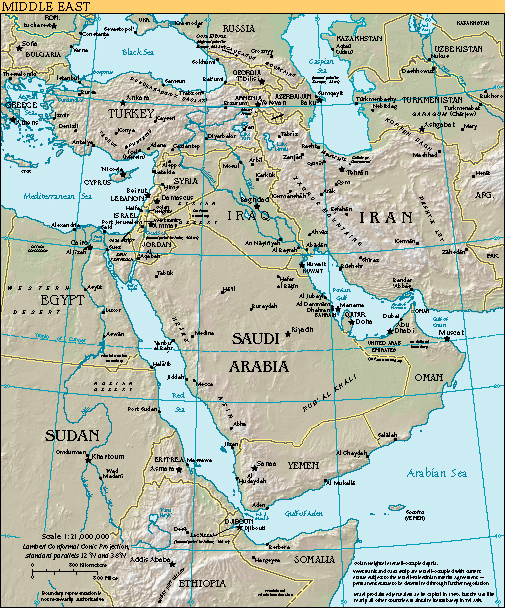
What does make sense is we've surrounded Iran. On Iran's western flank, there's a solid wall: Saudi Arabia, Kuwait, Iraq, Turkey. On Iran's eastern flank, Pakistan and Afghanistan. Now look at Syria: Iraq on its southern flank, Turkey and Jordan friendly with the U.S., chased out of Lebanon...
We've surrounded and isolated two of the most turbulent states in the mideast, and outright invaded and occupied the third. OK, so in a sense, that is “splitting the western-haters,” but I don’t think there’s any evidence that they were cooperating in an anti-western agenda. More like each has their own ambitions in the mideast. Saddam Hussein is a Baathist. The goal of the Baath Party is to create a pan-Arabic state. I’m hazarding a guess, here, and perhaps Woodsy can correct me if I’m wrong, but I would guess that Syria has ambitions to recreate the Ummayad Empire, at least in the middle east. And there is historical precedent for an Iranian empire in the middle east as well. So, my semi-informed opinion is that each of these states has ambitions to dominate mideast politics—after all, each has been historically powerful in the region, and the current national boundaries, and nation-states, were largely created by the British and French. From a historical perspective, we’re just newcomers on the scene, and have only been on the scene for a short period. Taking the long view, each state probably sees itself reestablishing its former glory, if not now, then after we’ve gone. That’s a very long way of saying that there’s no evidence to suggest that Syria, Iraq, and Iran would ever cooperate in some sort of anti-western agenda, except to the extent, perhaps, that such cooperation would further the national aspirations—to rule in the mideast—of these nations.
What makes more sense, to me, is that we’ve surrounded and isolated the most troublesome regimes in the mideast. The reason? We need the stability for our own economic security. We're probably at peak oil now, and world oil production will be declining from this point forward. The mideast still contains sizeable deposits of oil. China is a rapidly emerging power, perhaps to become a superpower in this century. China needs resources, including oil, to continue its rise. Stability in the mideast-- meaning governments stable enough, and friendly enough, to continue supplying oil to the west-- is essential for western economic security. We’ve surrounded and isolated the most troublesome nations in order to create that stability.
We are pulling our Army base out of Germany, which is at 1/3rd it's strength, and should be completely out by 2014??? Anyways that leaves a vacuum for our forward bases. I believe the intention is to keep a base in Iraq. Anytime there were missle strikes in the Middle East there were high costs to use the neighboring countries airzone. Iraq is right in the middle. There are alot of issues brewing in that area of the world, so to have a forward base in the area only makes sense.
In light of geopolitics, this fits perfectly with what we know. With the post-war reconstruction of Europe complete, and the demise of the Soviet Union, there is little if any reason for the United States to retain a large military presence in Germany. The military mission of our European bases—preventing the post-war rise to power of either fascists or communists, checking the advance of the Soviet Union—has been accomplished. The new geopolitics—the rise of anti-American extremists in a region that supplies a vital resource, the advance of an emergent Chinese superpower—argues for a new forward base in the mideast. Iraq may be the perfect place to situate an American military presence. It’s centrally located, it’s not the “holy land” (Saudi Arabia) so our presence there is less inflammatory, it borders Iran and Syria, occupying Iraq removes the third thorn in our side… It makes a lot of sense.
Creating a sympathetic Democratic state in The middle east could cause a change in the area (of course it did, but not quite as expected I think). Iraq has the possibilities becuase of oil. If the government could be put in place, they could bounce back financially with the wells they are sitting on. A good example of such a nation is Kuwait. Kuwait sells their oil as a nation and sends every citezen an annual check for an unbelievable amount (forgot exactly, but if I remember correctly it was around $25,000). If Iraq rebounds it could easily pay off alot of the costs paid to give them democracy/capatilism, and financially it's people could reenter the world market. This of course is all pending.
The only way Iraq will become and remain a “sympathetic democratic state” is if we create a “sympathetic democratic state” and remain in Iraq as “guests” to prevent any other possibility from occurring. First, Iraq is an artificial creation; there are at least three separate nations in Iraq—the Kurds, the Shiites, and the Sunnis. The Sunnis are a minority, and are the only Iraqis that want an Iraqi state, but the Iraqi state they want is the one they had—with them running things. The Shiites want, at a minimum, autonomy, and perhaps nationhood. The Kurds want nationhood, but will settle for autonomy as long as we’re in their way. The only thing holding this cobbled-together Frankenstein whole was brute military force. In the absence of brute military force, the separate nations will go their separate ways.
As you noticed while you were there, the Iraqi people have little sense of “democracy.” They’re not alone.
You mention Kuwait as an example of a “sympathetic democratic state.” Kuwait is certainly sympathetic, because the Brits made the state a protectorate, guaranteeing that the al-Sabah family would continue to rule. Kuwait is not a democracy, however—it’s a monarchy, with severely restricted voting rights. I suppose if you’re an aristocratic oilman, however, Kuwait looks like a model government.
As for Iran, I think there is one big reason we are interested in it right now. Iran wants Iraq, and revenge for the bloody Iran/Iraq war. Iran has never really acknowledged Iraq as it's own country, it believes it belongs to Iran, along with all it's oil. With Iraq tetering on whether it will be a sucess or not and the pressure to leave early, it would leave Iraq ripe for the picking. Iran with a nuculear warhead could possibly take over Iraq as the world watches, because of the fear that they will use a Nuke warhead. Use the words "nucular warhead" and the UN would buckle.
First, I doubt Iran is interested in Iraq as it is now constituted. I do believe Iran would like the Shiite portion of Iraq, either as a satellite state, or as part of a greater Iran. I doubt, however, that Iran is developing nuclear weapons in order to take control of Shiite Iraq. If Iran wants Shiite Iraq, there are other ways to accomplish that—through elections, for example. Through secession. Iran doesn’t need nuclear weapons to take Shiite Iraq. Looking at the map again, I think the reason Iran is developing nuclear weapons is because we’ve surrounded Iran, and the Ayatollahs feel their Islamic revolution being threatened. Iran undoubtedly has aspirations to exercise its historic power in the mideast, and with the emergence of China as a competitor for resources, a powerful Iran would become even more powerful, even more wealthy, even more influential. Think the west and China competing for resources, with Iran deciding who gets what, and at what price. The U.S. has already embarked on a course that secures the mideast resources for itself, however. If Iran is to remain independent, and pursue its own agenda, it needs the ability to withstand U.S. military might. Nuclear weapons would make a U.S. invasion of Iran exceedingly costly.
So that’s one possibility—that Iran is feeling threatened, and is developing nuclear weapons as a deterrent. Another possibility is that Iran is hoping to lure us into military confrontation, on the theory that we’re already overextended, and an invasion of Iran would break our back militarily, at least in the mideast. Or maybe it’s a little of both.
In any event, I think it’s clear that the “gubbins with Iran” is about their pursuit of nuclear weapons, and if anything, the petroeuro theory is just one of a bundle of benefits we would anticipate recouping if we were to invade Iran, but is not the motivating factor.
wow comrade, that is quite an essay. I have made my points above somewhere. I have not changed my position on the issue.
mainly that all that aggro with iran is a good reason to justify a military reason in the region.
i for one don't believe that iran actually poses any real danger (yet) to any of its neighbours. if it did a quick air strike would settle that, and the arab states would probably keep quiet as well, as there is no love lost between them and the persians.
Anyone else having problems with posting? Keeps erasing what I write. AAARRRGGGG!!!!!!
Anyways, ron and comrade, great points, agree with both of you mostly. Comrade, wow, great indepth explination, alot of that I was trying to say in less words. Agree with your refinements as well.
Ron, only beef, is that I think Iraq CAN be successful, but it won't be anytime soon. It will definately take a few generations to accept a new way of life. A new govt like a mirror to the US is too fast and they aren't ready for it. Think it should have a strong "born" leader and elected president and congress/parliment. The "born" leader slowly fades into the backround, similar to Japan's emperor and Britian's Queen. The transition in their mindset would be alot smoother, and would help them to slowly grasps all the new freedoms they have.
Comrade, Jordan keeps being refered as friendly to the US. . .yes and no. The government is "friendly" so we use their people as workers for Iraq. However there are alot of Jordanian insurgents (the believed master mind Zarquawi is Jordanian for one). Quite honest, with alot of dealings with Jordanians that were aiding our cause, they are really crooked and treat the rest of the Middle Easterns as animals (to include Indians as well). How they treated people amazed me. Those people really need a couple courses on human rights.
JHC
68 Pontiac wrote: Anyone else having problems with posting? Keeps erasing what I write. AAARRRGGGG!!!!!
Are you being timed out? Before you hit "submit", copy your text first, in case you get timed out. That way, if you get timed out, you can just log back in and paste your text into a reply. Alternatively, write in word and then cut & paste.
Thanks will keep that in mind, see my edit on the above post? Noticed yours hit before my edit.
JHC
68 Pontiac wrote: Comrade, Jordan keeps being refered as friendly to the US. . .yes and no. The government is "friendly"
Yeah, that's what I meant.
68 Pontiac wrote: Anyone else having problems with posting? Keeps erasing what I write. AAARRRGGGG!!!!!!
Anyways, ron and comrade, great points, agree with both of you mostly. Comrade, wow, great indepth explination, alot of that I was trying to say in less words. Agree with your refinements as well.
Ron, only beef, is that I think Iraq CAN be successful, but it won't be anytime soon. It will definately take a few generations to accept a new way of life. A new govt like a mirror to the US is too fast and they aren't ready for it. Think it should have a strong "born" leader and elected president and congress/parliment. The "born" leader slowly fades into the backround, similar to Japan's emperor and Britian's Queen. The transition in their mindset would be alot smoother, and would help them to slowly grasps all the new freedoms they have.
JHC
just one problem with this born leader. the middle east does not have a great track record of such leaders disappearing. they tend to hang onto power. heck this born leader could turn into the next sadam hussain.
